
What it is
Oversight work is a logistics problem wearing a compliance deadline.
Somebody has to visit every site. Somebody has to know which ones are overdue, which had findings last year, whether the corrective action ever closed, and whether the hours on file are still right.
Most programs run this on a shared drive: a spreadsheet for the schedule, a second one for findings, a folder of visit forms, and one person who knows where everything is. It works until it doesn't — until a formula breaks, a row gets inserted, or that person takes a job somewhere else.
PinLyne puts the sites, the routes, and the records in one place. You plan the day, drive it, and file what you found — the site, the date, and the history are already there.
Public agencies
You oversee sites you don't operate.
State distributing agencies · Child nutrition agencies · County and city departments
Your subrecipients run the sites. You are accountable for whether they run them correctly, and for producing the record that proves it when a reviewer asks.
PinLyne holds the monitoring schedule for every site you administer — TEFAP, CSFP, NSLP, FDPIR, or all of them at once — flags what has gone overdue, and keeps findings and corrective actions attached to the visit that raised them.
Entitlement carryover expires in two years. PinLyne shows you what’s unspent and how long you have left before it’s gone.
Nonprofit organizations
You supply a network you answer for.
Food banks · Distribution networks · Disaster relief organizations · School nutrition programs
You move product through partners you don't employ. Each one has its own hours, its own contacts, its own last visit date — and no guarantee the hours on file are still the hours they keep.
PinLyne runs every program against one site list, so a single visit can satisfy more than one requirement. When a disaster activates, the same list and the same routing hold up under pressure.
Your network doesn’t stop at a state line. Sites, monitoring schedules, and records work the same whether you cover one county or twelve states.
In the product
Built from the work, not from a template.
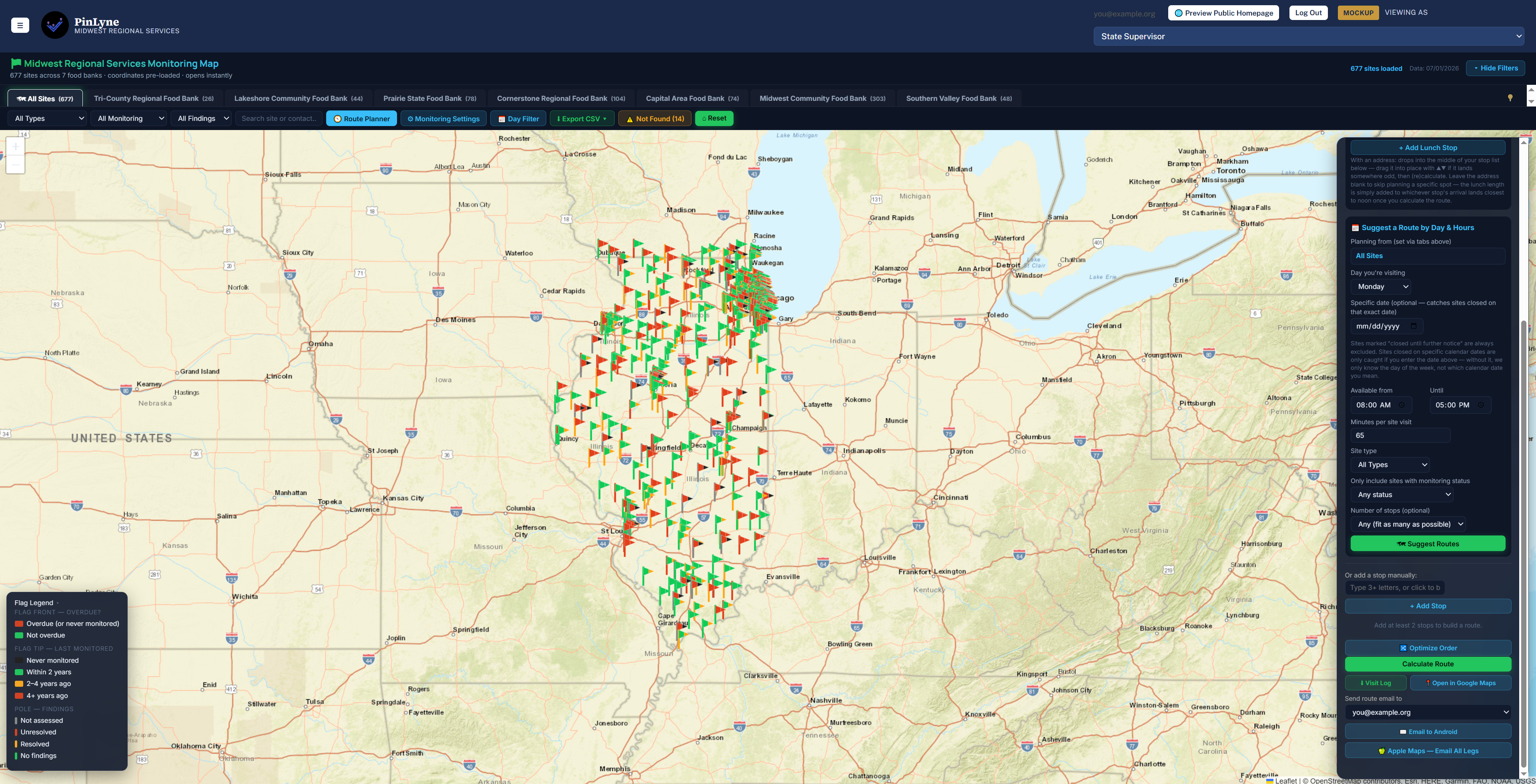
Tell it the day, get the route. PinLyne picks which sites to visit based on when they’re actually open, how long since each was last monitored, and which ones still have findings open. Then weights and builds route options however you need them: shortest driving, tightest schedule, or most overdue first. Hit send and the whole route is on your monitor's phone: Android or Apple, opening in the maps app they already use. No app to install, nothing to retype.
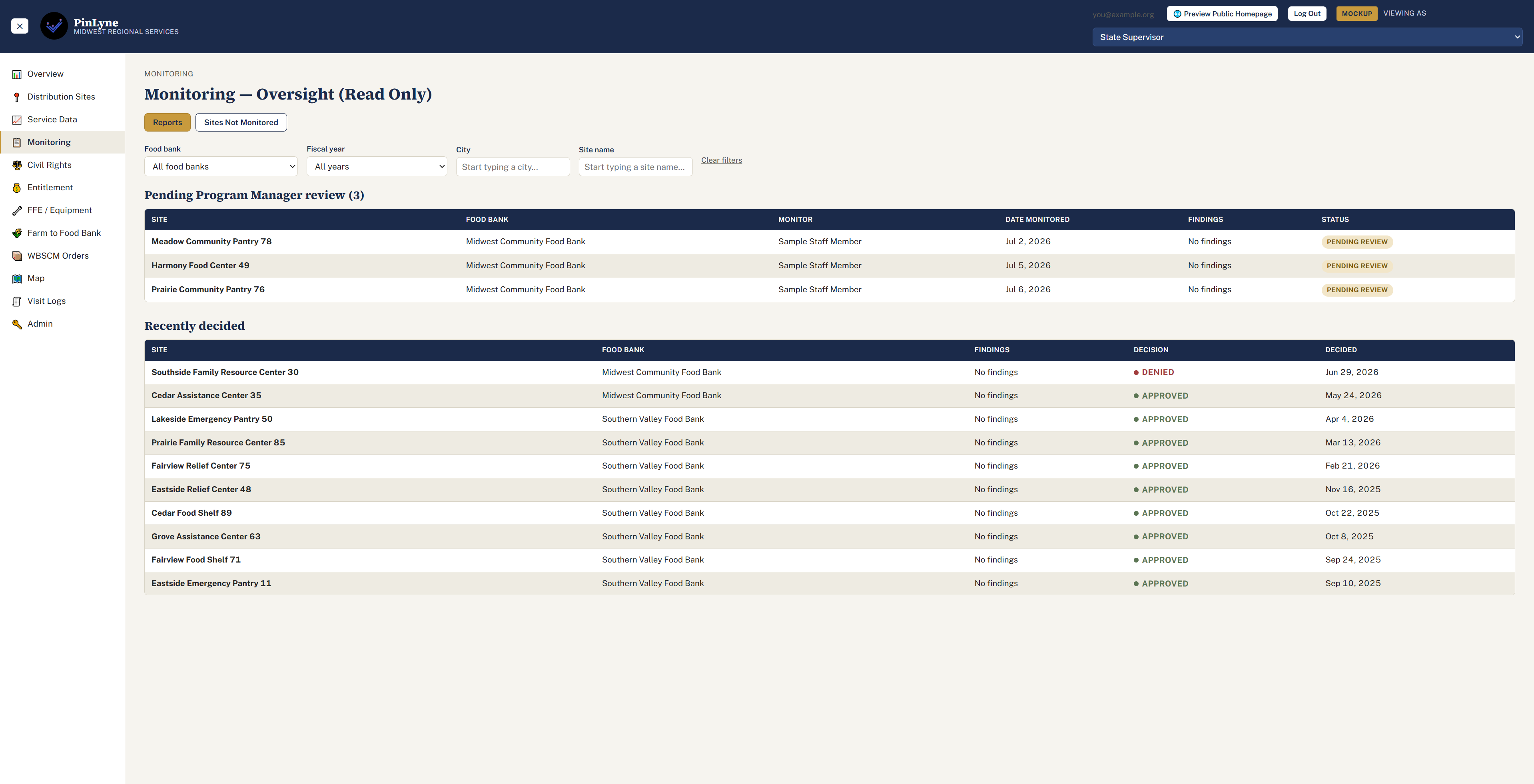
See the whole cycle at once. Which sites are current, which are overdue, and by how long. Findings stay attached to the visit that raised them, and corrective actions stay open until someone closes them.
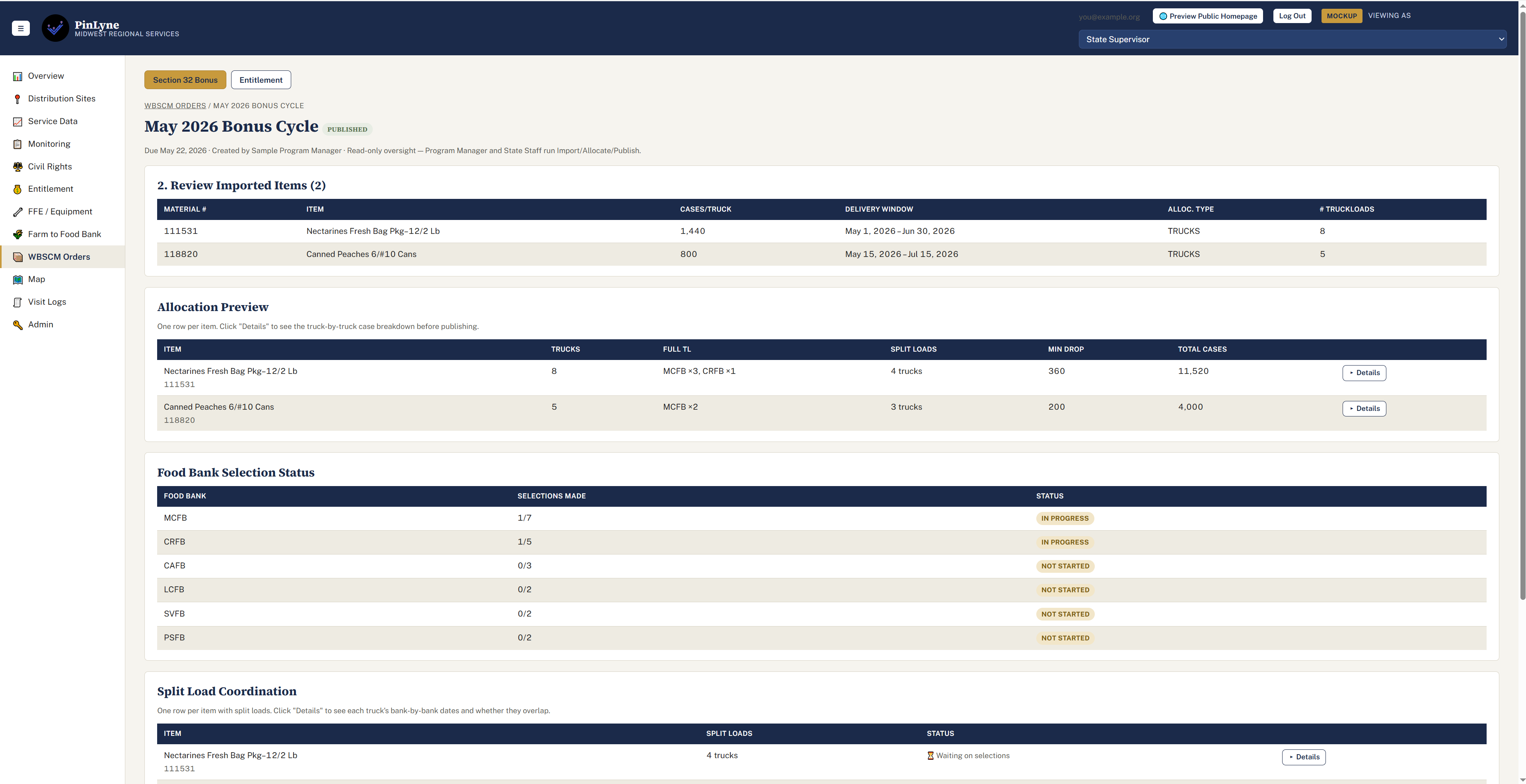
The ordering half, not just the paperwork. Import the offering file and PinLyne builds the allocations, the per-site order forms, and the delivery-date picker — for TEFAP, CSFP, FDPIR, NSLP, or all of them at once. The part nobody else automates because it takes knowing how WBSCM actually works.
Capabilities
Everything the program already does, in one system. Faster, and more accurately — so the hours go back into running the program and serving families, not buried in paperwork.
- Site directoryAddresses, hours, contacts, and closure notes — geocoded and searchable, across as many states as your network covers.
- Route optimizationMulti-stop routing across hundreds of sites, scheduled against each one’s actual hours — including split shifts and set-week openings.
- Hours as your partners wrote themExisting hours convert automatically, with anything ambiguous flagged for review rather than guessed.
- Monitoring schedulesCoverage tracking by cycle, with overdue sites surfaced automatically.
- Findings & corrective actionsAttached to the visit that raised them, open until resolved.
- Civil rights recordsAnnual training submissions and discrimination complaint tracking.
- Change historyEvery edit and approval recorded against the person who made it.
- Equipment & approvalsPrior written approval workflows with a durable request history.
- Visit logsOne entry per visit, with the site and date already filled in.
- Service reportingPeriod reporting with submission deadlines and late tracking.
- WBSCM OrdersImport the offering, generate allocations, and collect delivery dates from every site.
- Your data stays yoursEach organization sees only its own sites, staff, and records. Enforced in the database, not just the interface.
Talk to us
Stop spending all day buried in spreadsheets. Import your site list, your staff, and the visits you’ve already done — and PinLyne has your network mapped, routable, and showing you what’s overdue before the day is out. The FNS offering file goes in the same way, and comes back as allocations and delivery dates.
Request a demo